
Tokyo's oldest temple, and what that means
Senso-ji is often called Tokyo's oldest temple. That describes the institution, which has been in Asakusa for well over a thousand years by tradition. It does not describe the buildings. The main hall, the gates and the pagoda you see today are modern reconstructions, mostly from the 1950s to the 1970s.
The full name is Kinryuzan Senso-ji. The temple honors Kannon, the bodhisattva of compassion. Keep two things apart as you read: the founding story, which is a tradition, and the dated record of what was built and rebuilt.
The founding story
How the temple tells its own beginning.
18 March 628
According to tradition, two brothers, Hinokuma Hamanari and Hinokuma Takenari, were fishing in the Sumida River when they pulled up a statue of Kannon. Haji no Nakatomo set up a place of worship for it. Treat the year 628 as the date of a tradition, not the age of any building.
645
By tradition, the priest Shokai built a hall and kept the statue out of view. The hidden image is not on public display. A statue placed in front of it can be shown once a year at a ceremony on 13 December at 14:00.
Not a Shinto shrine
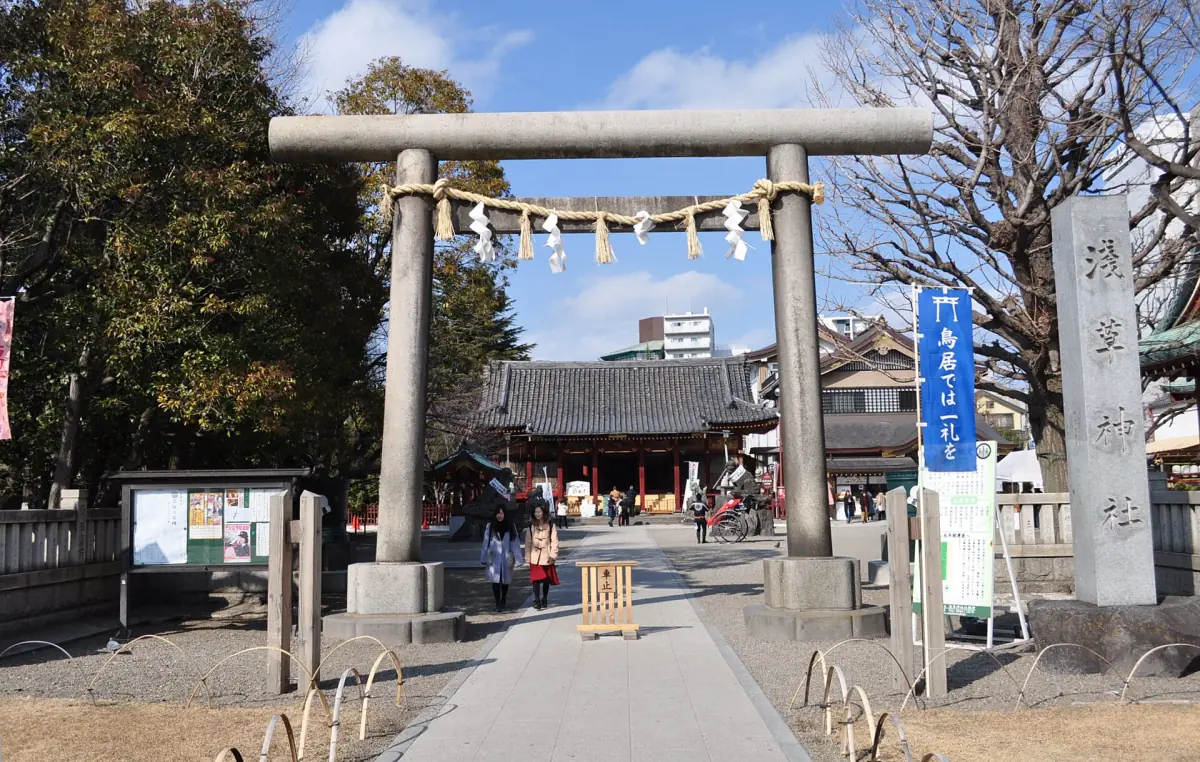
Senso-ji is Buddhist. Next to it stands the Asakusa Shrine, which is Shinto and honors the three people of the founding story. The two sit side by side, but they are separate places.
Senso-ji and Asakusa walking tours
Guided walks with background on the temple and its neighbourhood, with live prices and availability.
Rebuilt after 1945
What was lost and what came back.
The earlier main hall was destroyed in the air raid on Tokyo on 10 March 1945. The present main hall dates from 1958 and was paid for with donations. The Asakusa Shrine next door was different. Its building from 1649 came through the war and was repaired in 1996. That is also a reminder not to say that everything around the temple was lost.
The temple's religious ties changed too. Until 1949 it belonged to the Tendai school. Since 1950 it has been the head temple of the Sho Kannon school. If an older guide calls Senso-ji a Tendai temple, that is out of date.
| Part | Present building | Notes |
|---|---|---|
| Main hall | 1958 | Rebuilt with donations after the 1945 destruction |
| Kaminarimon | 1960 | Earlier gate burned in 1865; funded by a gift from Konosuke Matsushita |
| Hozomon | 1964 | Inner gate with two guardian figures |
| Five-storey pagoda | 1973 | Tip about 53 m above the ground |
| Asakusa Shrine | 1649 | Survived the war; repaired in 1996 |
The gates, the street and the pagoda
The buildings you pass on a visit, with their dates.
Kaminarimon
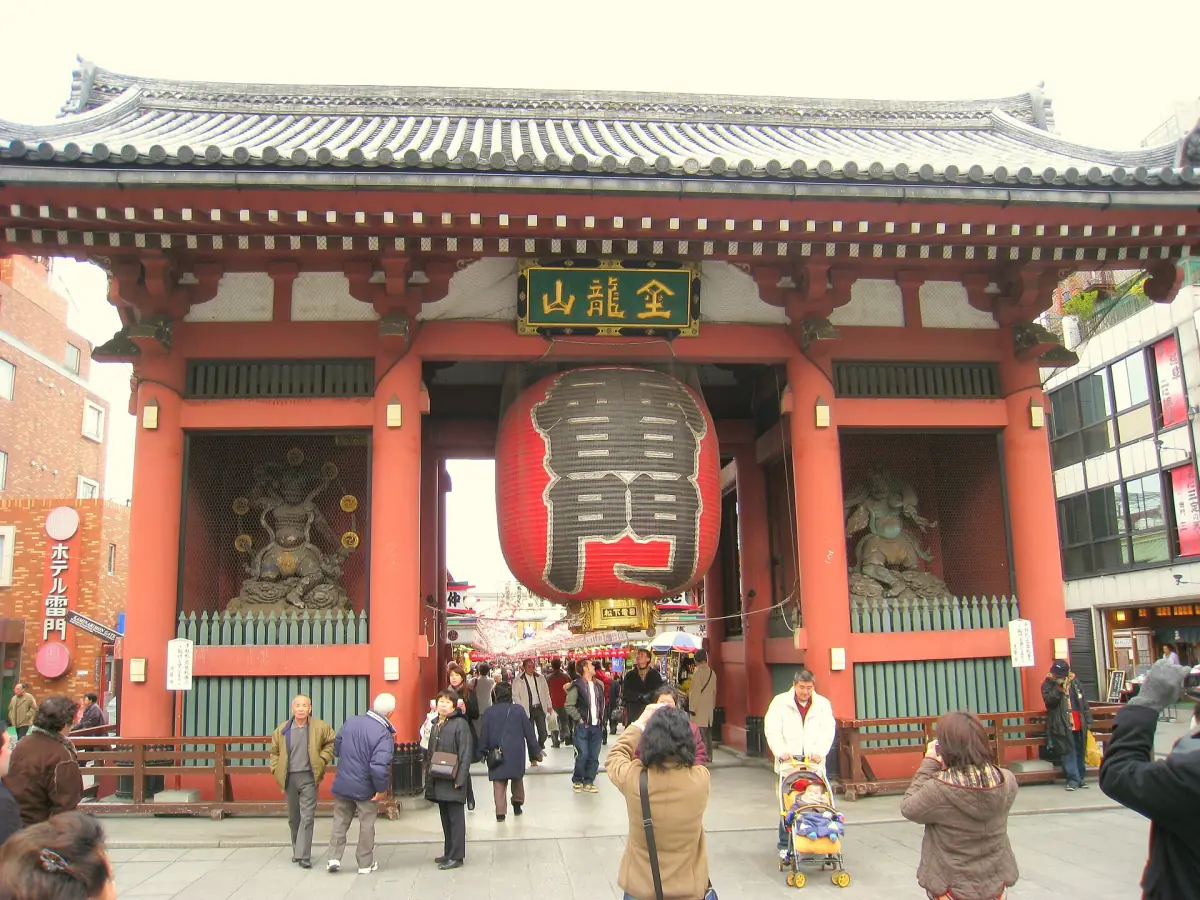
The outer gate is 11.7 m high and 11.4 m wide. Its giant lantern is 3.9 m high, 3.3 m wide and weighs about 700 kg. The lantern was last replaced in April 2020, the sixth replacement.
Kaminarimon guide →Nakamise-dori
The shopping street between the two gates dates to the late 1600s or early 1700s. Dates given run from around 1685 to the years 1688–1735.
Nakamise-dori guide →Hozomon
The inner gate was rebuilt in 1964. It houses scriptures and temple treasures, and visitors cannot climb to its upper floor. Its lantern is 3.75 m high and weighs about 450 kg.
The pagoda
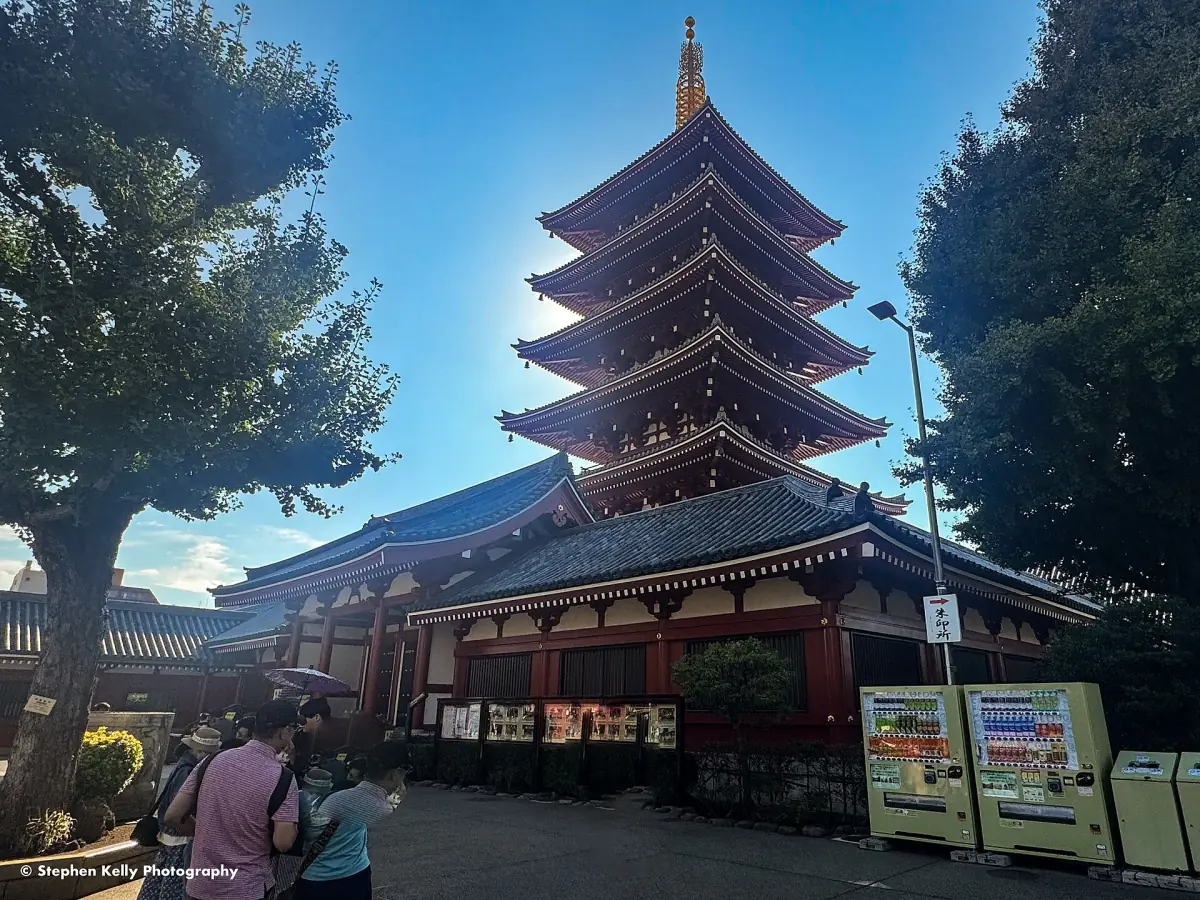
The five-storey pagoda was rebuilt in 1973 and stands to the southwest of the main hall. The top level holds Buddha relics given by Sri Lanka. You cannot climb it as a viewing tower.
How to read the dates
Three kinds of year appear in the story.
Legend years
628 and 645 belong to the founding tradition. They tell you how the temple understands its own beginning, not when a building was put up.
Building years
1649 for the Asakusa Shrine, then 1958, 1960, 1964 and 1973 for the main hall, Kaminarimon, Hozomon and the pagoda. These are the ages of the structures you actually see.
Event years
1865 for the fire at the earlier Kaminarimon, 1945 for the air raid, 1949 and 1950 for the change of religious school. These explain why so much is modern.
Traditions that continue
The yearly calendar is part of the temple's history.
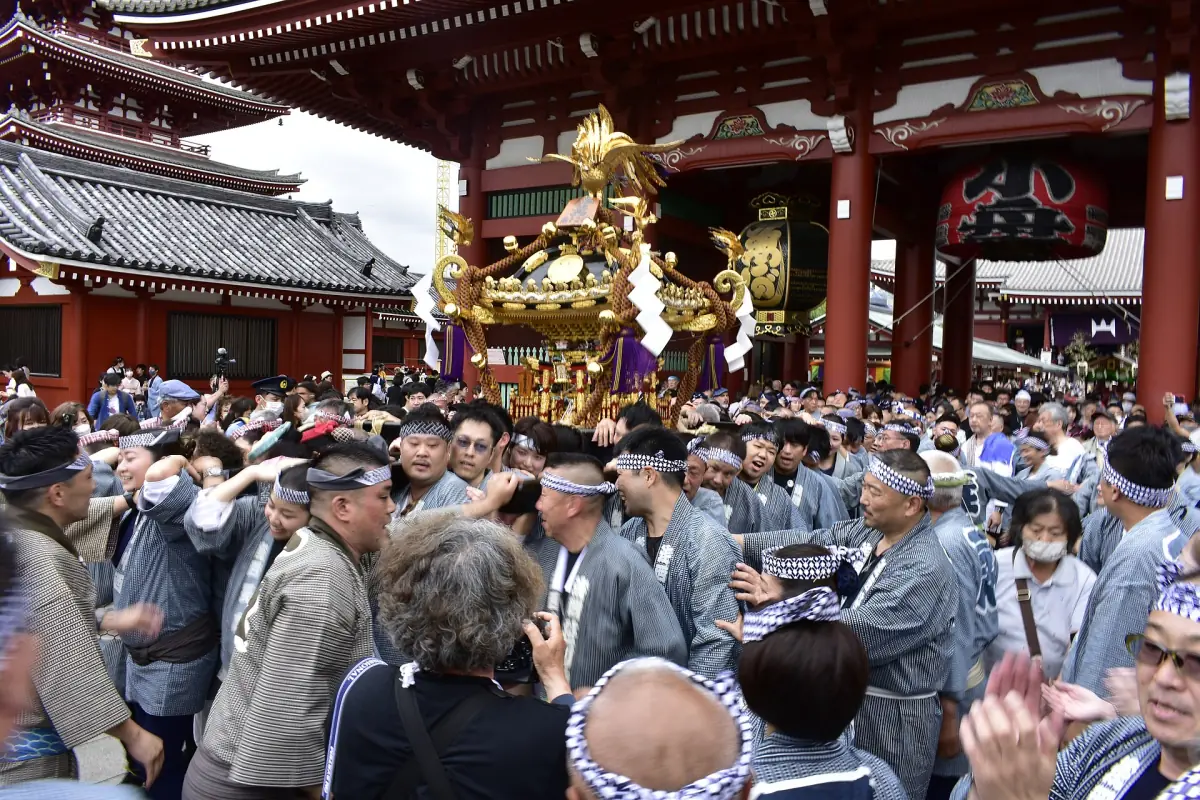
The temple keeps a yearly cycle of events. The new-year visit, Hatsumode, runs from 1 to 7 January. Hozuki-ichi, the market for lantern plants, takes place on 9 and 10 July. Hagoita-ichi, the market for decorative paddles, runs from 17 to 19 December. A major May festival is Sanja Matsuri, held by the Asakusa Shrine next door. The 2027 dates are 14 to 16 May and may change.
Kaminarimon
The gate, its lantern and the 1960 rebuilding.
Sanja Matsuri
The May festival, with 2027 dates.
Asakusa
The Asakusa Shrine and the streets around the temple.
If you travel on from Asakusa, Shibuya shows another, much newer side of Tokyo.
History of Senso-ji: frequently asked questions
When was Senso-ji founded?
By tradition in 628, when two brothers are said to have found a statue of Kannon in the Sumida River. Treat the year as a tradition and not as the age of any building.
Is the main hall original?
No. The earlier hall was destroyed on 10 March 1945. The present main hall was rebuilt in 1958 with donations.
Is Senso-ji a Tendai temple?
It was until 1949. Since 1950 it has been the head temple of the Sho Kannon school.
Can I see the Kannon statue?
The central image stays hidden. A statue placed in front of it can be shown once a year at a ceremony on 13 December at 14:00.
When was Kaminarimon built?
The present gate dates from 1960. The earlier one burned down in 1865, and the new gate was funded by a gift from Konosuke Matsushita.
Can I climb the pagoda?
No. The five-storey pagoda, rebuilt in 1973, is seen from the ground. Its top level holds Buddha relics given by Sri Lanka.
When was the Asakusa Shrine built?
The present building dates from 1649 and survived the war. It was repaired in 1996.