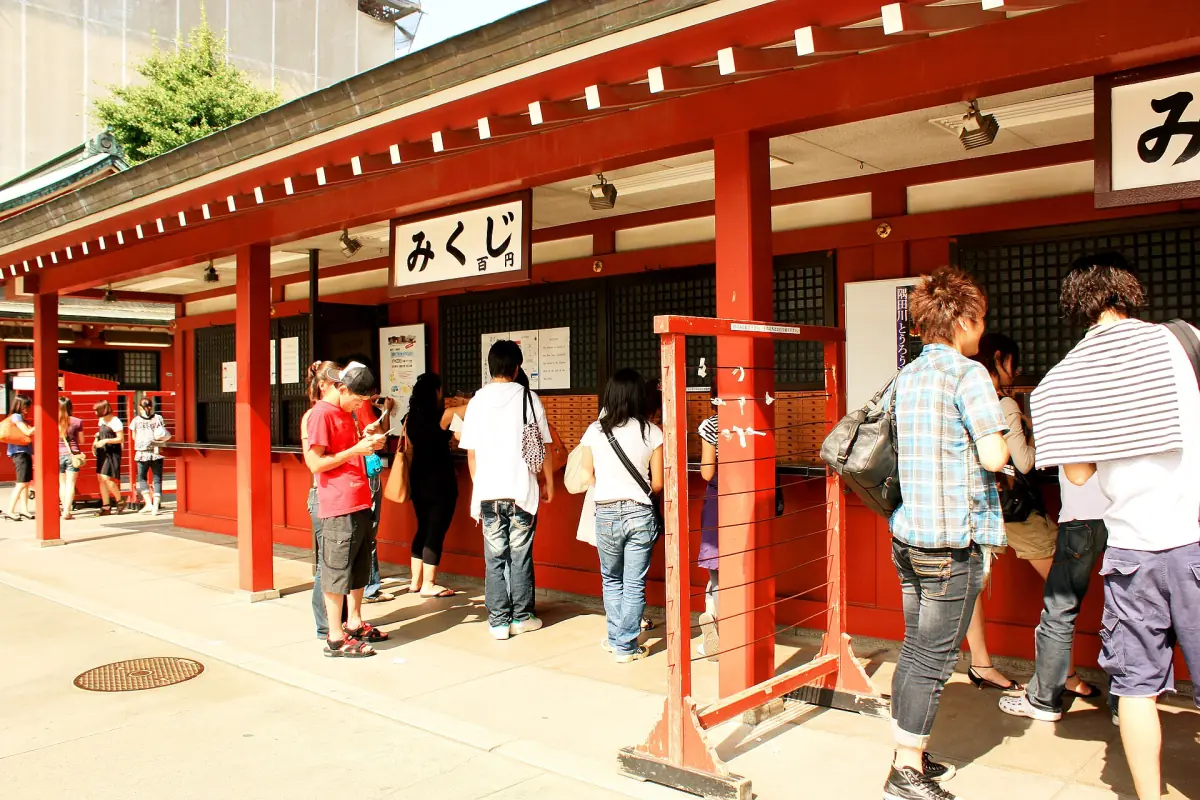
Omikuji at Senso-ji
Omikuji are paper fortunes. At Senso-ji you draw one yourself: you pay, shake a container, take out a numbered stick and collect the slip with the same number. It takes a couple of minutes and needs no booking, so it fits easily into a visit to the main hall.
The fortune system here is called Kannon Hyakusen, after Kannon, the bodhisattva of compassion to whom the temple is devoted. People who draw a fortune here treat it as guidance from the tradition, not as a forecast. Read it as something to think about.
How to draw an omikuji, step by step
The order is the same for everyone.
1. Pay
Put JPY 100 into the slot. The price is the amount given for 2026; check the sign at the box in case it has changed.
2. Shake the container
Shake the container and draw one numbered stick from it.
3. Find your drawer
Look at the number on the stick and open the drawer with the same number. Take one slip from it.
4. Return the stick
Put the stick back into the container. The temple asks that you always put it back.
Guided visits to Senso-ji and Asakusa
Walking tours, tastings and rickshaw rides near the temple, with live prices and availability.
What to do with your fortune
It depends on what the slip says.
| Result | What visitors do | Why |
|---|---|---|
| A good fortune | Keep it with you | Many people take it as a personal reminder; there is no rule that you must tie it |
| A bad fortune (kyo) | Tie the slip at the place provided on the grounds | In the tradition, a bad fortune is no cause for fear |
In this tradition, a bad fortune does not have to mean a bad outcome. Sincere and patient behaviour is said to turn it toward the good. This is a belief, so it is a thought to carry, not a promise of an outcome.
A typical route through the temple
Where the omikuji sits in a normal first visit.
2. Nakamise-dori
A shopping street of about 250 m leads to the inner gate. Shop hours vary.
3. Hozomon and the main hall
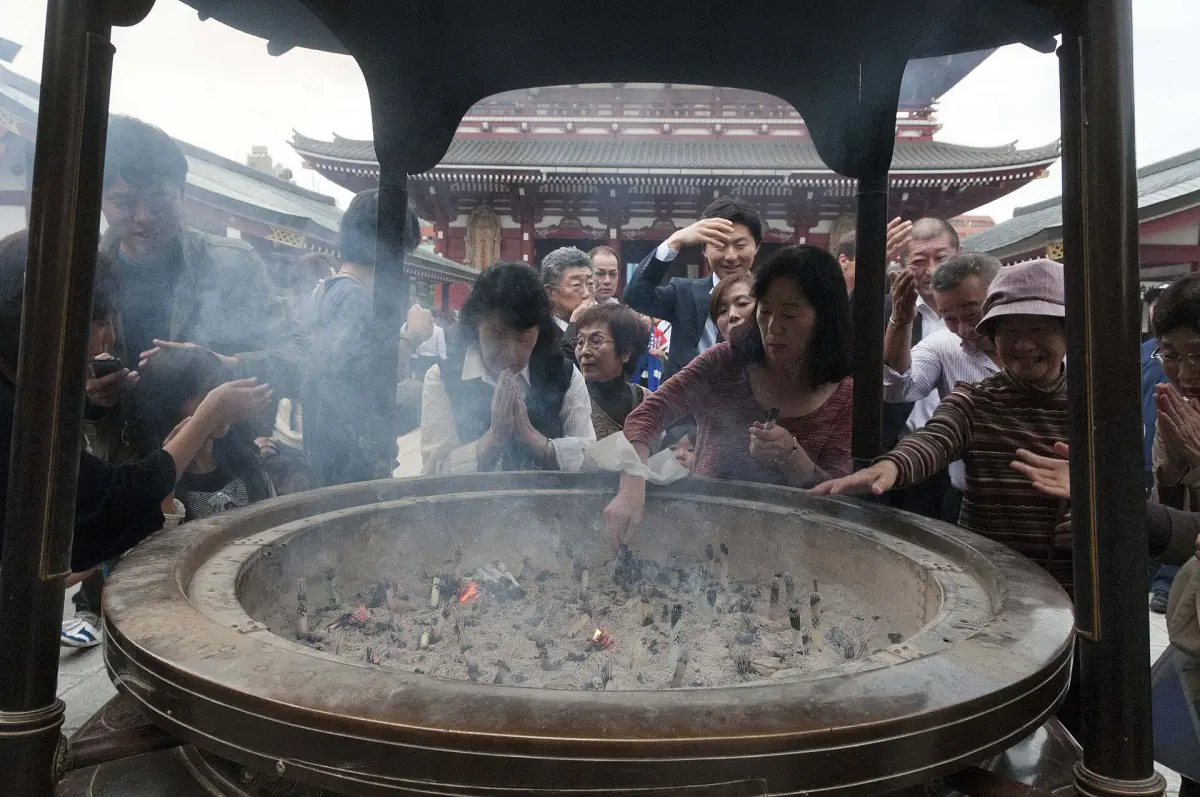
Past the inner gate you reach the incense burner and the main hall, where visitors pray.
4. The fortune
The omikuji is a short stop on the grounds. After it, you can walk to the pagoda or on to the Asakusa Shrine next door.
Where it fits in your visit
The omikuji is part of a normal visit, so there is no separate trip.
After the main hall
You can draw an omikuji on the same visit as the main hall. The route through Kaminarimon, Nakamise-dori and Hozomon leads you there, and the grounds are free to enter.
Nakamise-dori guide →With the incense
The incense burner stands in front of the main hall. Visitors waft the smoke toward themselves, and some link this to health. That is a belief and not a medical claim. The etiquette page covers the full routine.
Etiquette at Senso-ji →Timing
The grounds are open around the clock, and the main hall opens at 06:00 from April to September and at 06:30 from October to March, closing at 17:00. Check the signs on site rather than assuming the omikuji is available at every hour.
Opening hours →Good to know
Small points that make it smoother.
Bring a coin
Bring a JPY 100 coin so you do not need to break a larger note at the box.
Do not take the stick
The stick is not a souvenir. It goes back into the container, and only the paper slip is yours.
Know the place
If you want to know who the temple honors and how the grounds came to look as they do, read the history page before you go.
History of Senso-ji →A different Tokyo day
If you have more days in the city, Shibuya's viewpoints make a good contrast to a quiet temple morning.
Omikuji at Senso-ji: frequently asked questions
How much does an omikuji cost at Senso-ji?
JPY 100 in 2026. Look at the sign at the box in case the amount has changed.
How do I draw an omikuji?
Put in JPY 100, shake the container, draw one numbered stick, then take the slip from the drawer with the same number. Put the stick back into the container.
What if I draw a bad fortune?
Tie the slip at the place provided on the grounds. In this tradition, a bad fortune is not a reason to be afraid, and sincere, patient conduct is said to turn it for the better.
Should I keep a good fortune?
Many people do, as a personal guide. There is no rule that you must tie it up.
Do I need to book or pay an entry fee?
No booking is needed for a regular visit, and the grounds are free to enter. Only the fortune itself costs money.
When is the main hall open?
From 06:00 to 17:00 from April to September, and from 06:30 to 17:00 from October to March. The grounds are open around the clock.
Is the omikuji a prediction?
No. It is a religious practice with its own meaning for believers, and it does not promise any result. Read it as something to reflect on.